The whistles got louder and louder. Joe Gomez was standing on the touchline at the Parc des Princes, using a towel to dry the ball before he could take a throw-in, and the locals were not impressed.
The Liverpool defender looked uncomfortable, but he kept on drying. Eventually, with the noise reaching a crescendo and the referee hurrying him along, he hurled the ball into the penalty area. Nothing came of it, but at least he had given Paris Saint-Germain something to think about — even if their supporters took it as an affront.
Football has entered a new era of pragmatism: long throws, low blocks, corner kicks turned into wrestling matches, contests reduced to battles of attrition, the beautiful game as re-interpreted by number-crunchers and set-piece analysts.
Nobody, it seems, has broken that news to Luis Enrique and his PSG team. While others, notably in the Premier League, have sacrificed fluency at the altar of pragmatism, the PSG coach has doubled down on his philosophy: creative, free-flowing, possession-based football, played at speed with verve and elan.
This, in the Champions League quarter-final first leg, was another masterclass from the European champions, who beat Liverpool far more convincingly than the 2-0 scoreline suggests. It was Vitinha recycling the ball with such elegance, authority and precision. It was Achraf Hakimi and Nuno Mendes charging forward constantly from the full-back positions. It was Desire Doue and Khvicha Kvarataskhelia beguiling and tormenting their opponents, wreaking havoc and smiling as they did so.
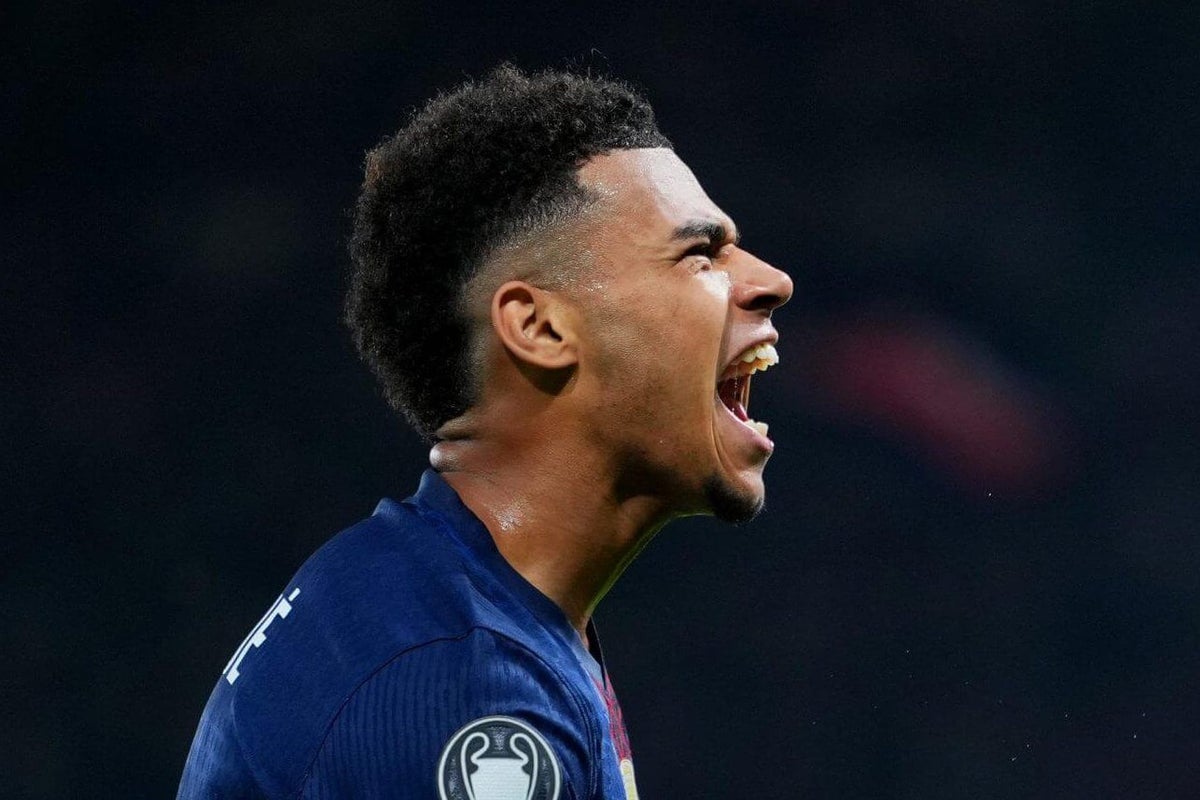
Their performance peaked on 65 minutes when a 27-pass move culminated with Joao Neves threading a pass into space beyond Liverpool’s reinforced back line for Kvaratskhelia, weaving inside, to dribble past his Georgian international team-mate Giorgi Mamardashvili and score PSG’s second goal.

Kvaratskhelia celebrates his goal — PSG’s second (Justin Setterfield/Getty Images)
That goal had stemmed from a throw-in too, taken by Hakimi to Warren Zaire-Emery. It took 27 passes — always probing with purpose — to get to that point. The best teams use throw-ins to retain possession and build, rather than merely to launch the ball and hope it drops invitingly in a crowded penalty area.
In Luis Enrique’s post-match press conference, The Athletic asked him about his sustained commitment to an ultra-creative, ultra-technical approach at a time when this season’s trends in the Premier League have been towards more attritional playing styles and increased emphasis on set pieces.
“I can’t analyse other teams,” the PSG coach said. “Every team, (the) manager has to choose the way he has to play. Liverpool is one of the teams that plays better. They use the set pieces also in the same way, but this is not our style. We try to play the best football, we try to have fun with our supporters, trying to show them the way we play, in an offensive way, trying to create superiority in every part of the pitch and that’s our idea, that’s our mentality. We never choose players by (whether) they are tall or short. We try to play in our style.”
Vitinha is the one who makes everything tick. He completed 132 passes, which is precisely two-thirds as many as the entire Liverpool starting XI plus their five substitutes. Even those numbers do not reflect the way he enabled PSG to establish control and to set – and change — the tempo of the game as if he was flicking at a switch. When his coach talks of “trying to create superiority in every part of the pitch”, it stems from that area in the same way that Pep Guardiola’s — and later Luis Enrique’s — great Barcelona team built around a midfield of Sergio Busquets, Xavi and Andres Iniesta.
Liverpool coach Arne Slot characterised PSG afterwards as a team with “so many weapons” and “pace from everywhere”. He described the pace of Hakimi and Mendes as an “unbelievable offensive threat”, adding, “It’s not even running. It’s not even sprinting. It’s a level above sprinting.”
That combination of speed (the full-backs) and incisive trickery (the wingers) is in stark contrast to the way Liverpool have slowed down and lost their cutting edge in wide areas this season. But even the two best teams in the Premier League, Arsenal and Manchester City, have carried nothing like PSG’s attacking threat on the wings. The speed, intelligence and variety of PSG’s attacking movements are a tribute to their coach’s vision and conviction as well as the skill of the players in question.
What a player Kvaratskhelia is. You often hear it said that there are no real flair players in today’s game — no dribblers, no mavericks, just a load of automatons who have had the joy and spontaneity coached out of them — but the Georgia forward makes a mockery of such talk. So do Bradley Barcola, who missed the game last night through injury, and the 20-year-old Doue. Look at Michael Olise and Luis Diaz at Bayern Munich, Lamine Yamal and Raphinha at Barcelona and Vinicius Jnr at Real Madrid, and you see highly talented players thriving in wide positions.
It is all so different from the direction of travel in the Premier League, where Slot has spent much of this season lamenting the trend towards low-risk football built around corner kicks and long throws. Slot has positioned himself as a purist, saying that his “football heart” treasures “the Barcelona team from 10 to 15 years ago” — Luis Enrique’s Barcelona team, in other words, and Guardiola’s before that.
Yet here was Slot reverting in desperation to a three-man central defence as his Liverpool team found themselves doing some of the very things — timewasting, those long throws from Gomez, a mere 69 per cent pass completion in the first half — he has expressed distaste about when opponents have made life difficult for them in the Premier League.
Being terrified of the opposition, while doubting his own team and perhaps also his job security, can do that to a coach. It didn’t stem the flow of attacks from the French side, but, as Slot asked afterwards, “Have you ever seen a team play tactics over here that didn’t allow PSG to constantly have the ball and create chance after chance after chance?” He said he had seen a variety of teams pitch up at the Parc des Princes with a variety of gameplans, “but the result is always the same: PSG blowing the opponent away.”
It is not quite true. But since the start of last year, PSG have faced English opponents in the Champions League on 12 occasions: beating Manchester City 4-2, beating Liverpool 1-0 (and ultimately prevailing on penalties, having lost the first leg by the same scoreline), beating Aston Villa 3-1 (and losing to them 3-2 in the second leg at Villa Park), beating Arsenal 1-0 and 2-1, beating Tottenham Hotspur 5-3, drawing 1-1 with Newcastle United, beating Chelsea 5-2 and 3-0 and now beating Liverpool again 2-0. Over 12 games, that amounts to 28 goals scored and 14 goals conceded. In at least half of those games, last night being the latest, the gulf in attacking and creative quality was enormous.
There will be the usual rush to attribute those results to the advantages PSG are perceived to enjoy because their domestic league is far less intense than the Premier League.
Such benefits do exist, particularly when PSG have had this weekend’s Ligue 1 fixture against second-placed Lens postponed to help them recover before next Tuesday’s second leg at Liverpool. But is it really so hard to believe that a team containing Hakimi, Mendes, Vitinha, Joao Neves, Kvaratskhelia, Doue et al, flourishing under Luis Enrique’s enlightened leadership, has simply performed at a technical level beyond any Premier League team over the past 12 months or so, their Club World Cup final defeat by Chelsea notwithstanding?

Luis Enrique’s side played with verve and elan on Wednesday night (Anne-Christine Poujoulat/AFP via Getty Images)
It doesn’t guarantee that they will win the Champions League again. Even this season’s Liverpool, even at 2-0 down, will give it a go at Anfield next Tuesday. Beyond that, Bayern, 2-1 up in their quarter-final tie against Real Madrid, are their likely semi-final opponents and Arsenal or Atletico Madrid, having won their respective quarter-final first legs, could lie in wait in the final in Budapest.
But whether PSG retain their European title or not, the way they are performing is a welcome challenge to the growing orthodoxy about the need to embrace stop-start football — every throw-in, free kick and corner kick turned into an event – rather than a fast, free-flowing style.
The sight of Liverpool in what Slot called “survival mode”, scrapping for second balls and waiting for the next Gomez long-throw opportunity to come, said an awful lot about their regression since the two teams met last season and their paths diverged. But it also reflected PSG’s growing aura and their success, after years of falling short on the European stage, in building a team that is becoming revered as well as feared.